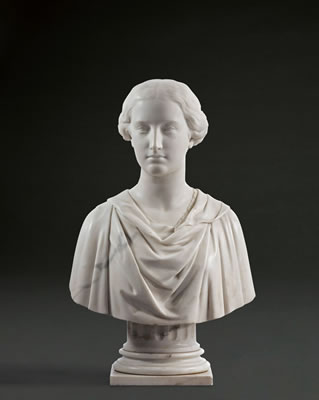
Erastus Dow Palmer is significant to art historians as the first well-known American Neo-Classical* sculptor to pursue his professional career at home rather than abroad in Italy. He was a sculptor... Read full biography
Erastus Dow Palmer is significant to art historians as the first well-known American Neo-Classical* sculptor to pursue his professional career at home rather than abroad in Italy. He was a sculptor whose themes were often religious, especially dominated by Christianity, and the tone was often... Read full biography
Erastus Dow Palmer is significant to art historians as the first well-known American Neo-Classical* sculptor to pursue his professional career at home rather than abroad in Italy. He was a sculptor whose themes were often religious, especially dominated by Christianity, and the tone was often romantic and melodramatic. He was born at Pompey, New York, and first worked as a carpenter and pattern maker, carving wood molds, and then took up cameo cutting. However, his eyesight suffered with the... Read full biography
Erastus Dow Palmer is significant to art historians as the first well-known American Neo-Classical* sculptor to pursue his professional career at home rather than abroad in Italy. He was a sculptor whose themes were often religious, especially dominated by Christianity, and the tone was often romantic and melodramatic. He was born at Pompey, New York, and first worked as a carpenter and pattern maker, carving wood molds, and then took up cameo cutting. However, his eyesight suffered with the detail work, and instead he modeled portrait busts in clay, and then worked them in marble*. The detailed work was detrimental to his eyesight, however, and he turned to modeling portrait busts* in clay later to be put into marble. In 1849, Palmer... Read full biography
Erastus Dow Palmer is significant to art historians as the first well-known American Neo-Classical* sculptor to pursue his professional career at home rather than abroad in Italy. He was a sculptor whose themes were often religious, especially dominated by Christianity, and the tone was often romantic and melodramatic. He was born at Pompey, New York, and first worked as a carpenter and pattern maker, carving wood molds, and then took up cameo cutting. However, his eyesight suffered with the detail work, and instead he modeled portrait busts in clay, and then worked them in marble*. The detailed work was detrimental to his eyesight, however, and he turned to modeling portrait busts* in clay later to be put into marble. In 1849, Palmer began exhibiting at the National Academy of Design* in New York City, and in 1856, had a one-man show at the Church of the... Read full biography