Although Jean Dewasne studied architecture at the School of Fine Arts in Paris, he chose to become a painter when discovering Kandisky and Mondrian. His first exhibition took place in the Esquisse... Read full biography
Although Jean Dewasne studied architecture at the School of Fine Arts in Paris, he chose to become a painter when discovering Kandisky and Mondrian. His first exhibition took place in the Esquisse Gallery in 1941. Four years later, committed to abstraction art together with Arp, Hartung, Poliakoff... Read full biography
Although Jean Dewasne studied architecture at the School of Fine Arts in Paris, he chose to become a painter when discovering Kandisky and Mondrian. His first exhibition took place in the Esquisse Gallery in 1941. Four years later, committed to abstraction art together with Arp, Hartung, Poliakoff and Staël, he was honored with the Kandinsky prize at the Salon des Réalités Nouvelles (1945). Disagreeing with its restrictive aesthetic orientation, Dewasne resigned from the Salon des Réalités... Read full biography
Although Jean Dewasne studied architecture at the School of Fine Arts in Paris, he chose to become a painter when discovering Kandisky and Mondrian. His first exhibition took place in the Esquisse Gallery in 1941. Four years later, committed to abstraction art together with Arp, Hartung, Poliakoff and Staël, he was honored with the Kandinsky prize at the Salon des Réalités Nouvelles (1945). Disagreeing with its restrictive aesthetic orientation, Dewasne resigned from the Salon des Réalités Nouvelles in 1949 and together with Edgard Pillet (1912-1996) he founded the Atelier de l'Art Abstrait (Abstract Art Studio). Exploring what he termed the "technology of painting," based on chemistry, colorimetry, mathematics, and the physiology of... Read full biography
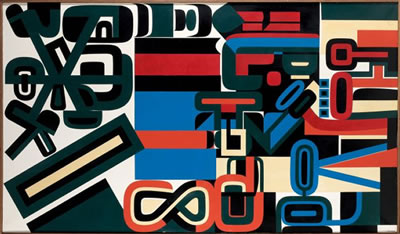
Although Jean Dewasne studied architecture at the School of Fine Arts in Paris, he chose to become a painter when discovering Kandisky and Mondrian. His first exhibition took place in the Esquisse Gallery in 1941. Four years later, committed to abstraction art together with Arp, Hartung, Poliakoff and Staël, he was honored with the Kandinsky prize at the Salon des Réalités Nouvelles (1945). Disagreeing with its restrictive aesthetic orientation, Dewasne resigned from the Salon des Réalités Nouvelles in 1949 and together with Edgard Pillet (1912-1996) he founded the Atelier de l'Art Abstrait (Abstract Art Studio). Exploring what he termed the "technology of painting," based on chemistry, colorimetry, mathematics, and the physiology of vision, he championed the use of industrial materials, including alkyd paint, board (i.e., French Masonite) and sheet metal. In 1952... Read full biography