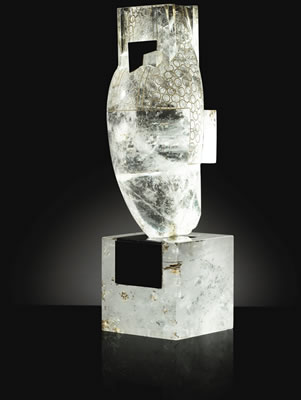
Joseph Csaky was born on March 18, 1888 in Szeged, Hungary. He studied for a short time at l'École des Arts Decoratifs in Budapest. In 1908 he moved to Paris where his work was influenced by the... Read full biography
Joseph Csaky was born on March 18, 1888 in Szeged, Hungary. He studied for a short time at l'École des Arts Decoratifs in Budapest. In 1908 he moved to Paris where his work was influenced by the styles of the French avant-garde. Rodin's post-romantic, lyric style was supplanted by Maillol's more... Read full biography
Joseph Csaky was born on March 18, 1888 in Szeged, Hungary. He studied for a short time at l'École des Arts Decoratifs in Budapest. In 1908 he moved to Paris where his work was influenced by the styles of the French avant-garde. Rodin's post-romantic, lyric style was supplanted by Maillol's more rigorous and sensual compositions. Eventually, Cubism also influenced Csaky's works. In 1909, Picasso produced his first cubist sculpture of a woman's head, and in 1914 Csaky created a similar work... Read full biography
Joseph Csaky was born on March 18, 1888 in Szeged, Hungary. He studied for a short time at l'École des Arts Decoratifs in Budapest. In 1908 he moved to Paris where his work was influenced by the styles of the French avant-garde. Rodin's post-romantic, lyric style was supplanted by Maillol's more rigorous and sensual compositions. Eventually, Cubism also influenced Csaky's works. In 1909, Picasso produced his first cubist sculpture of a woman's head, and in 1914 Csaky created a similar work titled La Tête Cubiste. Csaky fought with the French army during World War I. After the war he continued to examine the human form through his cubist sculptures. Csaky began to explore abstraction in 1919. He sculpted stone into tangles of spheres,... Read full biography
Joseph Csaky was born on March 18, 1888 in Szeged, Hungary. He studied for a short time at l'École des Arts Decoratifs in Budapest. In 1908 he moved to Paris where his work was influenced by the styles of the French avant-garde. Rodin's post-romantic, lyric style was supplanted by Maillol's more rigorous and sensual compositions. Eventually, Cubism also influenced Csaky's works. In 1909, Picasso produced his first cubist sculpture of a woman's head, and in 1914 Csaky created a similar work titled La Tête Cubiste. Csaky fought with the French army during World War I. After the war he continued to examine the human form through his cubist sculptures. Csaky began to explore abstraction in 1919. He sculpted stone into tangles of spheres, cones, and cylinders. Around 1928 he returned to a more realistic style of sculpture... Read full biography