Robert Stanley began his career as a pulp illustrator, and in the 1950s, he became "one of the two most prolific paperback cover artists employed by the Dell Publishing Company (the other was Gerald... Read full biography
Robert Stanley began his career as a pulp illustrator, and in the 1950s, he became "one of the two most prolific paperback cover artists employed by the Dell Publishing Company (the other was Gerald Gregg)." At one time he worked on the "Kansas City Journal" and the "Star" and "Times", so he was... Read full biography
Robert Stanley began his career as a pulp illustrator, and in the 1950s, he became "one of the two most prolific paperback cover artists employed by the Dell Publishing Company (the other was Gerald Gregg)." At one time he worked on the "Kansas City Journal" and the "Star" and "Times", so he was familiar with the set-up of a print shop. Before his employment at Dell, he produced covers for paperback companies including Bantam, Lion and Signet. Working for Dell, he is credited as being a major... Read full biography
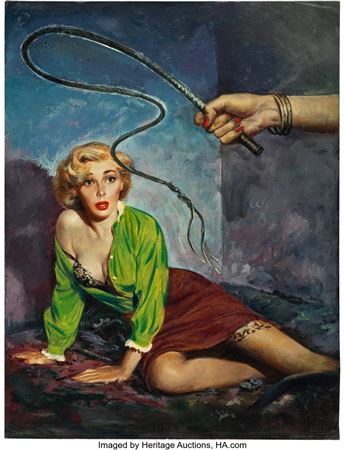
Robert Stanley began his career as a pulp illustrator, and in the 1950s, he became "one of the two most prolific paperback cover artists employed by the Dell Publishing Company (the other was Gerald Gregg)." At one time he worked on the "Kansas City Journal" and the "Star" and "Times", so he was familiar with the set-up of a print shop. Before his employment at Dell, he produced covers for paperback companies including Bantam, Lion and Signet. Working for Dell, he is credited as being a major contributor to the Dell image of the 1950s, which was action-packed illustrations of mysteries and westerns. His realism included "images of men fighting, cowboys riding, and women threatening or being threatened". Frequently he used himself and his... Read full biography
Robert Stanley began his career as a pulp illustrator, and in the 1950s, he became "one of the two most prolific paperback cover artists employed by the Dell Publishing Company (the other was Gerald Gregg)." At one time he worked on the "Kansas City Journal" and the "Star" and "Times", so he was familiar with the set-up of a print shop. Before his employment at Dell, he produced covers for paperback companies including Bantam, Lion and Signet. Working for Dell, he is credited as being a major contributor to the Dell image of the 1950s, which was action-packed illustrations of mysteries and westerns. His realism included "images of men fighting, cowboys riding, and women threatening or being threatened". Frequently he used himself and his wife Rhoda as models and occasionally used his father-in-law, Julius Rozenzweig, as well as his daughter. Stanley's wife, Rhoda,... Read full biography