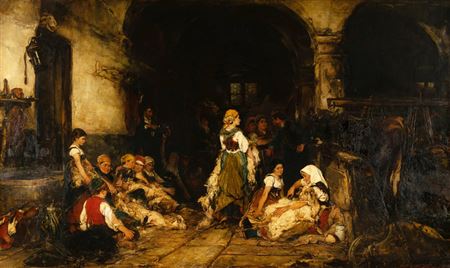
WALTER SHIRLAW. Walter Shirlaw, born on August 6, 1838, was only three (fourteen according to one obituary) when he came to Hoboken, New Jersey from his place of birth, Paisley, Scotland. As a young... Read full biography
WALTER SHIRLAW. Walter Shirlaw, born on August 6, 1838, was only three (fourteen according to one obituary) when he came to Hoboken, New Jersey from his place of birth, Paisley, Scotland. As a young man, he found work as a bank note engraver, a profession that he continued in Chicago, where he... Read full biography
WALTER SHIRLAW. Walter Shirlaw, born on August 6, 1838, was only three (fourteen according to one obituary) when he came to Hoboken, New Jersey from his place of birth, Paisley, Scotland. As a young man, he found work as a bank note engraver, a profession that he continued in Chicago, where he lived between 1865 and 1870. But already in 1861 he was exhibiting genre paintings at the National Academy of Design. In 1868, Shirlaw was a member of the Chicago Academy of Design, which would become the... Read full biography
WALTER SHIRLAW. Walter Shirlaw, born on August 6, 1838, was only three (fourteen according to one obituary) when he came to Hoboken, New Jersey from his place of birth, Paisley, Scotland. As a young man, he found work as a bank note engraver, a profession that he continued in Chicago, where he lived between 1865 and 1870. But already in 1861 he was exhibiting genre paintings at the National Academy of Design. In 1868, Shirlaw was a member of the Chicago Academy of Design, which would become the Art Institute of Chicago, after changing its name from the Chicago Academy of Fine Arts. Shirlaw spent the years 1870-77 in Munich, at the height of the movement led by Wilhelm Leibl in which a low-keyed, dark palette, combined with bold, virtuoso... Read full biography
WALTER SHIRLAW. Walter Shirlaw, born on August 6, 1838, was only three (fourteen according to one obituary) when he came to Hoboken, New Jersey from his place of birth, Paisley, Scotland. As a young man, he found work as a bank note engraver, a profession that he continued in Chicago, where he lived between 1865 and 1870. But already in 1861 he was exhibiting genre paintings at the National Academy of Design. In 1868, Shirlaw was a member of the Chicago Academy of Design, which would become the Art Institute of Chicago, after changing its name from the Chicago Academy of Fine Arts. Shirlaw spent the years 1870-77 in Munich, at the height of the movement led by Wilhelm Leibl in which a low-keyed, dark palette, combined with bold, virtuoso brushwork, were applied to realist subject matter. Michael Quick (in Quick, Ruhmer, and West, 1978, p. 28) d... Read full biography