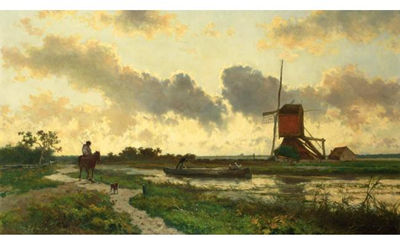
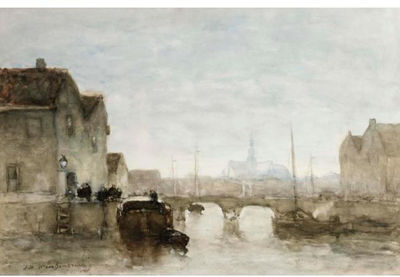
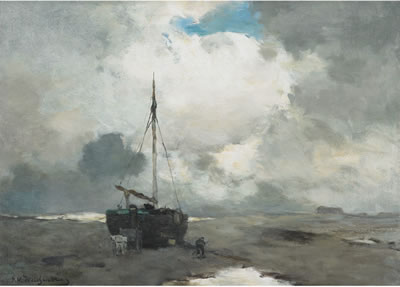
Jan Hendrik Weissenbruch was particularly fascinated with the permanently changing skies above the typically green polders around The Hague and later in the surroundings of Gouda and Boskoop. He was... Read full biography
Jan Hendrik Weissenbruch was particularly fascinated with the permanently changing skies above the typically green polders around The Hague and later in the surroundings of Gouda and Boskoop. He was fascinated in rendering light effects and tonal qualities of a subject. Once Weissenbruch told the... Read full biography
Jan Hendrik Weissenbruch was particularly fascinated with the permanently changing skies above the typically green polders around The Hague and later in the surroundings of Gouda and Boskoop. He was fascinated in rendering light effects and tonal qualities of a subject. Once Weissenbruch told the art dealer Van Harpen (1858-?): 'De lucht is de hoofdzaak in een schilderij. Als je lucht niet goed is, dan deugt je schilderij niet. De lucht beheerscht het heele landschap!.' (see: Hans Janssen, Wim... Read full biography
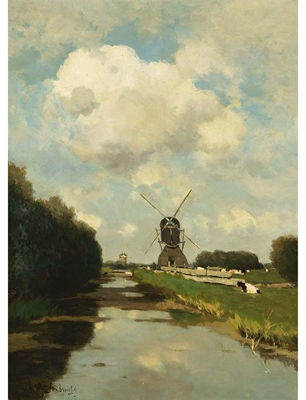
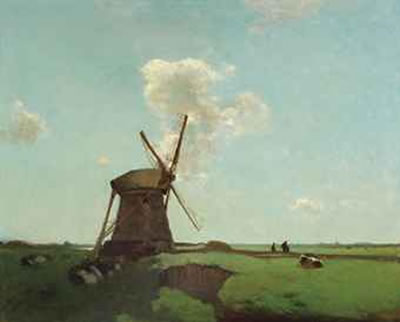
Jan Hendrik Weissenbruch was particularly fascinated with the permanently changing skies above the typically green polders around The Hague and later in the surroundings of Gouda and Boskoop. He was fascinated in rendering light effects and tonal qualities of a subject. Once Weissenbruch told the art dealer Van Harpen (1858-?): 'De lucht is de hoofdzaak in een schilderij. Als je lucht niet goed is, dan deugt je schilderij niet. De lucht beheerscht het heele landschap!.' (see: Hans Janssen, Wim van Sinderen, De Haagse School, Rotterdam, 1997, p. 46). Against the blue sky, seen from a lower viewing point, the majestic windmills are depicted to give the work a more dramatic atmosphere. The present lot is a typical example of Weissenbruch is... Read full biography
Jan Hendrik Weissenbruch was particularly fascinated with the permanently changing skies above the typically green polders around The Hague and later in the surroundings of Gouda and Boskoop. He was fascinated in rendering light effects and tonal qualities of a subject. Once Weissenbruch told the art dealer Van Harpen (1858-?): 'De lucht is de hoofdzaak in een schilderij. Als je lucht niet goed is, dan deugt je schilderij niet. De lucht beheerscht het heele landschap!.' (see: Hans Janssen, Wim van Sinderen, De Haagse School, Rotterdam, 1997, p. 46). Against the blue sky, seen from a lower viewing point, the majestic windmills are depicted to give the work a more dramatic atmosphere. The present lot is a typical example of Weissenbruch is considered one of the great interpreters of the Dutch landscape. Stimulated by the artistic milieu in The Hague wh... Read full biography
Johann Hendrik Weissenbruch - Art Prices in Auction LotsAuction Lots