Page loaded successfully. Showing biography for Fillia.
Fillia BIOGRAPHY
1904 Revello, Piedmont, Italy - 1936 Turin, Italy. Known for: Futurist painting.
In polycentric (and polymorphic) landscape of the future of the twenties, the positions of Pannaggi and - above all the ideological - of Paladins were unorthodox compared to the dominant line,... Read full biography
In polycentric (and polymorphic) landscape of the future of the twenties, the positions of Pannaggi and - above all the ideological - of Paladins were unorthodox compared to the dominant line, dictated by Marinetti, and much closer to the positions of futurism against Roman (Balla, Prampolini and... Read full biography
In polycentric (and polymorphic) landscape of the future of the twenties, the positions of Pannaggi and - above all the ideological - of Paladins were unorthodox compared to the dominant line, dictated by Marinetti, and much closer to the positions of futurism against Roman (Balla, Prampolini and Anton Giulio Bragaglia), who had always felt their freedom from Marinetti's line. No less autonomous than Marinetti, and close to Prampolini, was the location of the Turin Futurist group, which took... Read full biography
In polycentric (and polymorphic) landscape of the future of the twenties, the positions of Pannaggi and - above all the ideological - of Paladins were unorthodox compared to the dominant line, dictated by Marinetti, and much closer to the positions of futurism against Roman (Balla, Prampolini and Anton Giulio Bragaglia), who had always felt their freedom from Marinetti's line. No less autonomous than Marinetti, and close to Prampolini, was the location of the Turin Futurist group, which took shape on the occasion of the exhibition of 1922 at the Winter Club. Turin attracted many young people who came for the vehement anti-bourgeois, for the air of rioters and the opportunity for artists to circumvent the official models and at the same... Read full biography
In polycentric (and polymorphic) landscape of the future of the twenties, the positions of Pannaggi and - above all the ideological - of Paladins were unorthodox compared to the dominant line, dictated by Marinetti, and much closer to the positions of futurism against Roman (Balla, Prampolini and Anton Giulio Bragaglia), who had always felt their freedom from Marinetti's line. No less autonomous than Marinetti, and close to Prampolini, was the location of the Turin Futurist group, which took shape on the occasion of the exhibition of 1922 at the Winter Club. Turin attracted many young people who came for the vehement anti-bourgeois, for the air of rioters and the opportunity for artists to circumvent the official models and at the same time to be part of an organization capable of promoting their work. Fillia (actually called Luigi Colombo, but he chose now to b... Read full biography
Artist Biography
Biography page for Fillia ((1904 - 1936)), known for Futurist painting. Showing 2 biographical entries and 0 sample artworks.
Fillia - Artist Info
About Fillia
Name variants
Luigi Colombo
Biography from Christie's Milan
In polycentric (and polymorphic) landscape of the future of the twenties, the positions of Pannaggi and - above all the ideological - of Paladins were unorthodox compared to the dominant line, dictated by Marinetti, and much closer to the positions of futurism against Roman (Balla, Prampolini and Anton Giulio Bragaglia), who had always felt their freedom from Marinetti's line. No less autonomous than Marinetti, and close to Prampolini, was the location of the Turin Futurist group, which took shape on the occasion of the exhibition of 1922 at the Winter Club. Turin attracted many young people who came for the vehement anti-bourgeois, for the air of rioters and the opportunity for artists to circumvent the official models and at the same time to be part of an organization capable of promoting their work. Fillia (actually called Luigi Colombo, but he chose now to be known with only the mother's surname) was one of these. He met Marinetti at the Winter Club and April of 1923 and founded the Turin Futurist group with Nikolay Diulgheroff, Pippo Oriani, Enrico Alimandi, Franco Costa and the sculptor Mino Rosso, becoming its leader and ideologue.
Fillia would die young of tuberculosis in 1936, but in those few years he published art reviews from "Featured Futurist" to "Future City", from "The New Town" on "The Land of the Living", "Futurism" and "The Force". His theoretical contribution to the debate on art and then L'Aeropittura (Aeropainting), the dominant Futurist style of the 1930s which applied the experience of flight to the depiction of landscape aerially; the world was no longer seen from the perspective of the person on the ground but as if from an aeroplane. In 1929, he was a co-signatory of the Futurist manifesto L'Aeropittura, with Benedetta Cappa, Depero, Gerardo Dottori, Marinetti, Somenzi, Tato and Prampolini.
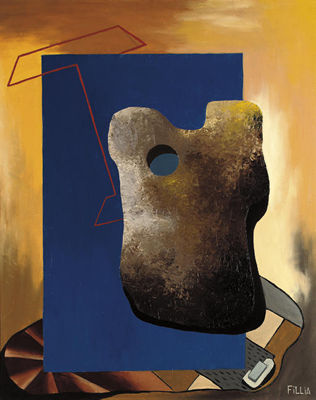
He was also a good painter, and during the twenties created a body of work, frankly mechanical, however, already tinged deeply spiritually. He wrote in 1925: "Every machine is its action, the absolute center of countless objects and connecting employees - so we call 'mechanical idols' performances of the various plastic machinery, making the sum of their strengths and sensations derived. presenting the public with the spiritual development caused by a car. " The car thus becomes a spiritual entity which informs him about himself, his "mechanical mind" artistic production, dictating laws of order and measure. (...) His paintings of the twenties are moving so in this climate: synthetic, rigorous, geometric forms made of clear and uniform color fields, represent a world informed by the "spirit" of the machine. By mid-decade, then, his works, like those of the first Prampolini "mechanical" (Prampolini was and will always be his model), are built with an "architecture of colored planes" rigorously geometric and dimensional, and with fields of color. (...)
At the end of the decade, with the series of paintings titled Femininity, Fillia appears to have started a new season: the colors fade, the volumes are returned at the same time you break up and become incorporeal and the human figure, although synthesized in geometric volumes, fills the entire picture at the expense of industrial forms that until then had dominated his compositions, a prelude to the paintings of the next decade. (A. Masoero, The Twenties. The mechanical art, in the future 1909-2009, Milan 2009, p. 226, 235)Biography from Bonhams Bond Street
Regarded as one of the leading Italian artists of the early twentieth century, Fillia (Luigi Colombo) founded the 'Turin's Futurist Movement' in 1923, ushering in the second wave of Futurism. The artist devotedly followed the credo of the Manifesto Futurista written in 1909 by the poet Filippo Tommaso Marinetti, with whom Fillia wrote several essays on art and culture.
This text and the analogous 'Manifesto of the Futurist Painters' written the following year, celebrated the beauty of urban modernity and technology, the myth of machines, progress and speed, declaring the intention to express such physical sensations of movement on the canvas:'We declare that the new splendour of the world has been increased by new beauty; the beauty of speed' (F.T. Marinetti, 'The Founding and Manifesto of Futurism' in Le Figaro, Paris, 20 February 1909).
In 1931 he exhibited in Paris at Galerie 23 alongside the avant-garde group 'Cercle et Carré', who included Le Corbusier, Schwitters, Léger, Kandinsky and Mondrian. Under the influence of the Cubist technique of fragmentation of forms and the juxtaposition of planes, Fillia reached his own personal and recognizable style, far from pure figurative painting and closer to the Divisionist and Symbolist theories.
Paesaggio (con chiesa e alberi) belongs to a series of almost metaphysical countryside landscapes. The intimate scene is permeated with melancholic spiritualism which contrasts with the vivid and energetic use of bright colors. Following the color theories of artists such as Kandinsky, Fillia emphasizes the symbolic meaning of color, declaring in his essay Alfabeto Spirituale (Spiritual Alphabet) of 1925, that colors are the entire subject and vital force of a painting.
The pigments he applies and the harmonious intersection of rounded and angular lines, together with the interplay of planes, create great dynamism in the work. The machine-like elements in the composition are also typically Futurist: the path resembles a blade and the furrows of the ploughed field remind the viewer of a mechanical wheel. Yet, in a move away from the early Futurist paintings, here Fillia is more concerned with the spiritual and psychological over the material.
The church stands as a strong symbol of salvation in the middle of the dark night and surrounding fields, removed from the vibrancy of the city. Fillia's strong spiritual beliefs enabled him to become one of the leading religious artists of the Futurist movement in Italy. Fillia wrote the 'Manifesto of Sacred Futurist Art' with Marinetti, which celebrated the intrinsic spiritual force within the arts and the possibility for art to be a transcendent experience.