Page loaded successfully. Showing biography for Frederic Bruly Bouabre.
Frederic Bruly Bouabre BIOGRAPHY
1921 Zéprégüé, Côte d’Ivoire - 2014. Known for: Painting.
Frédéric Bruly Bouabré was born in Zéprégüé, Côte d'Ivoire, in 1923 and is recognized as one of the greatest contemporary artists from West Africa. He was amongst the first of his generation from... Read full biography
Frédéric Bruly Bouabré was born in Zéprégüé, Côte d'Ivoire, in 1923 and is recognized as one of the greatest contemporary artists from West Africa. He was amongst the first of his generation from Côte d'Ivoire to be educated by the French colonial government. He was a self-taught artist - in the... Read full biography
Frédéric Bruly Bouabré was born in Zéprégüé, Côte d'Ivoire, in 1923 and is recognized as one of the greatest contemporary artists from West Africa. He was amongst the first of his generation from Côte d'Ivoire to be educated by the French colonial government. He was a self-taught artist - in the West he might have been viewed as an "outsider" though this term is meaningless in the African context. A fascination with language and literature permeates his work. 'Alphabet Bété' (1991/92), which... Read full biography
Frédéric Bruly Bouabré was born in Zéprégüé, Côte d'Ivoire, in 1923 and is recognized as one of the greatest contemporary artists from West Africa. He was amongst the first of his generation from Côte d'Ivoire to be educated by the French colonial government. He was a self-taught artist - in the West he might have been viewed as an "outsider" though this term is meaningless in the African context. A fascination with language and literature permeates his work. 'Alphabet Bété' (1991/92), which was shown at Documenta 2002, comprises an alphabet Bouabré invented, for Bété people, made up of over 400 signs which correspond to phonetic syllables. Bouabré was profoundly influenced by a vision he had on March 11th, 1948, when he witnessed seven... Read full biography
Frédéric Bruly Bouabré was born in Zéprégüé, Côte d'Ivoire, in 1923 and is recognized as one of the greatest contemporary artists from West Africa. He was amongst the first of his generation from Côte d'Ivoire to be educated by the French colonial government. He was a self-taught artist - in the West he might have been viewed as an "outsider" though this term is meaningless in the African context. A fascination with language and literature permeates his work. 'Alphabet Bété' (1991/92), which was shown at Documenta 2002, comprises an alphabet Bouabré invented, for Bété people, made up of over 400 signs which correspond to phonetic syllables. Bouabré was profoundly influenced by a vision he had on March 11th, 1948, when he witnessed seven suns orbiting round the sun. This revelatory experience lead him to embark on a lifelong mis... Read full biography
Artist Biography
Biography page for Frederic Bruly Bouabre ((1921 - 2014)), known for Painting. Showing 2 biographical entries and 0 sample artworks.
Frederic Bruly Bouabre - Artist Info
About Frederic Bruly Bouabre
Name variants
Frederic Bouabre
Biography from The Auction Room London
 Frédéric Bruly Bouabré was born in Zéprégüé, Côte d'Ivoire, in 1923 and is recognized as one of the greatest contemporary artists from West Africa. He was amongst the first of his generation from Côte d'Ivoire to be educated by the French colonial government.
He was a self-taught artist - in the West he might have been viewed as an "outsider" though this term is meaningless in the African context. A fascination with language and literature permeates his work. 'Alphabet Bété' (1991/92), which was shown at Documenta 2002, comprises an alphabet Bouabré invented, for Bété people, made up of over 400 signs which correspond to phonetic syllables.
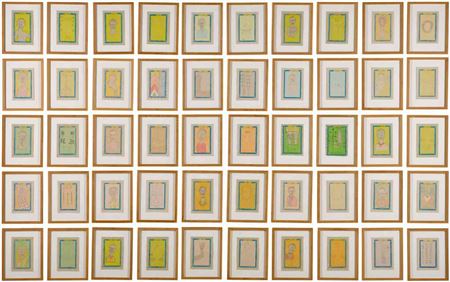
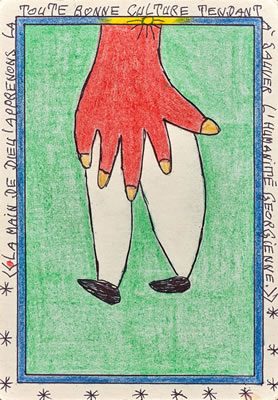
Bouabré was profoundly influenced by a vision he had on March 11th, 1948, when he witnessed seven suns orbiting round the sun. This revelatory experience lead him to embark on a lifelong mission of conducting and collecting research about art, religion, philosophy and other fields of knowledge. In the 1970's he began illustrating his thoughts and created hundreds of postcard sized drawings, using crayons and a ballpoint pen. These small drawings almost always form part of a series, of which the principal one is 'Connaissance du Monde'. For many years his drawings were intended primarily for his own ethnic group.
Frédéric Bruly Bouabré's works first gained international exposure in 1989 when exhibited in 'Magiciens de la Terre', at the Pompidou Centre in Paris. Since then he has participated in a number of major international exhibitions including; Documenta 11 (2002), Africa Remix (2004) and African Art Now: Masterpieces from the Jean Pigozzi Collection (2005).Biography from Auctionata
Frédéric Bruly Bouabré was a self-taught artist, active in poetry and painting. His early poems, stories, and drawings were mainly focused on language and identity.
After he had a religious vision in 1948, Bouabré produced and continuously expanded a number of different work cycles, in which he tried to trace the world in its entirety. Bouabré was a tribesman of the Bété, who significantly depended on their orally preserved tradition. Bouabré therefore developed a syllabary, in order to document the language and culture of his people. The Africa explorer Théodore Monod (1902-2000) was the first who published it in 1958.
Bouabré also created numerous small-scale drawings which resemble the art of pictograms. In Europe, the artist gained attention in the late 1980s and his works were exhibited at the Centre Pompidou in Paris, the Biennale in Venice, and the documenta in Kassel.