Page loaded successfully. Showing biography for Joseph Floch.
Joseph Floch BIOGRAPHY
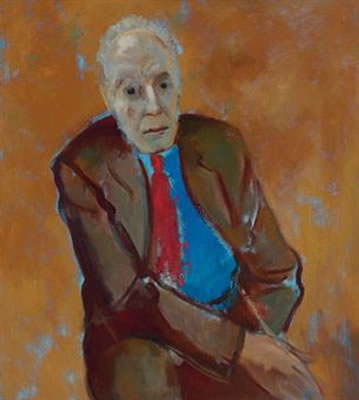
1895 Vienna, Austria - 1977 New York. Known for: Mod figure-genre, still life.
Although Floch enjoyed some success early in his career in Vienna, his wish to leave his homeland became ever greater in the years following the First World War. In his diary, which is published here... Read full biography
Although Floch enjoyed some success early in his career in Vienna, his wish to leave his homeland became ever greater in the years following the First World War. In his diary, which is published here for the first time, Floch noted, full of bitterness, 'Vienna is the city of music, painting takes... Read full biography
Although Floch enjoyed some success early in his career in Vienna, his wish to leave his homeland became ever greater in the years following the First World War. In his diary, which is published here for the first time, Floch noted, full of bitterness, 'Vienna is the city of music, painting takes second place.' In 1918 Floch travelled to Munich, where he saw pictures by Paul Cézanne, Vincent van Gogh and Hans von Marées for the first at the Pinakotek, which left a deep impression on the young... Read full biography
Although Floch enjoyed some success early in his career in Vienna, his wish to leave his homeland became ever greater in the years following the First World War. In his diary, which is published here for the first time, Floch noted, full of bitterness, 'Vienna is the city of music, painting takes second place.' In 1918 Floch travelled to Munich, where he saw pictures by Paul Cézanne, Vincent van Gogh and Hans von Marées for the first at the Pinakotek, which left a deep impression on the young artist - and subsequently on his understanding of art. From then on, he was fascinated by the art of others and, restless, he undertook journeys to the Netherlands, Dalmatia and Italy, although, above all, to Trieste, where relatives of his lived; in... Read full biography
Although Floch enjoyed some success early in his career in Vienna, his wish to leave his homeland became ever greater in the years following the First World War. In his diary, which is published here for the first time, Floch noted, full of bitterness, 'Vienna is the city of music, painting takes second place.' In 1918 Floch travelled to Munich, where he saw pictures by Paul Cézanne, Vincent van Gogh and Hans von Marées for the first at the Pinakotek, which left a deep impression on the young artist - and subsequently on his understanding of art. From then on, he was fascinated by the art of others and, restless, he undertook journeys to the Netherlands, Dalmatia and Italy, although, above all, to Trieste, where relatives of his lived; in 1923 he travelled to Palestine for a period of six months. Floch made important contacts in Vienna at this time with fellow artists and... Read full biography
Artist Biography
Biography page for Joseph Floch ((1895 - 1977)), known for Mod figure-genre, still life. Showing 3 biographical entries and 0 sample artworks.
Joseph Floch - Artist Info
About Joseph Floch
Name variants
Josef Floch
Biography from the Archives of askART
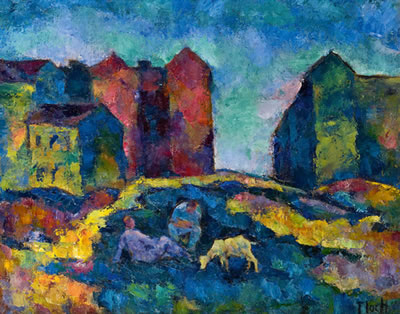 Although Floch enjoyed some success early in his career in Vienna, his wish to leave his homeland became ever greater in the years following the First World War. In his diary, which is published here for the first time, Floch noted, full of bitterness, 'Vienna is the city of music, painting takes second place.' In 1918 Floch travelled to Munich, where he saw pictures by Paul Cézanne, Vincent van Gogh and Hans von Marées for the first at the Pinakotek, which left a deep impression on the young artist - and subsequently on his understanding of art.
From then on, he was fascinated by the art of others and, restless, he undertook journeys to the Netherlands, Dalmatia and Italy, although, above all, to Trieste, where relatives of his lived; in 1923 he travelled to Palestine for a period of six months. Floch made important contacts in Vienna at this time with fellow artists and collectors, particularly the art critics, Erika and Hans Tietze. Although Floch's pictures were sufficiently good to be exhibited at the Viennese Secession, he joined the conservative artist society, the Hagenbund in 1919, becoming one of their best-known members until the society was dissolved in 1938... Karl Pallauf, excerpt from foreword, op.cit.Biography from Butler Institute of American Art
Joseph Floch- Born Vienna, Austria November 5, 1895; died 1977.
Education: Academy of Fine Arts in Vienna.
Exhibitions: Pennsylvania Academy of Fine Arts 1944 (prize); Paris Salon 1937 (medal); Association of American Artists; Whitney Museum of American Art 1945; Washington County Museum of Fine Art 1945; Toledo Museum of Art 1942; Corcoran Gallery of Art 1945; Art Institute of Chicago 1943; Carnegie Institute 1943 - 1945
Holdings: Museums in United States, France, Austria and Israel.Biography from Karl & Faber Kunstauktionen
The focus in Josef Floch's work is the turn to landscape and figure painting. The artist focuses on isolated and calm people and their environment, which is often designed as a shelter for the sitter. The present painting is representative of this main focus in his work. It probably shows Nelly Hammerschlag, whom Josef Floch portrayed several times. The painting was owned by Chana Orloff for some time. She was a recognized Franco-Israeli artist who became one of the most important artists of the École de Paris between the wars in Paris.
Josef Floch is a renowned artists of the 20th century in Austria, whose work has undergone a renaissance and in recent years has started to soar on the auction markets. The return to Josef Floch and his art began with a large solo exhibition in the Austrian Belvedere Gallery in 1972 and continues to this day. In addition to the Belvedere, his pictures are in many important collections around the world. The artist was trained at the Vienna Academy of Fine Arts from 1913 to 1919. After traveling through Palestine, Munich, southern France and Spain, he moved to Paris in 1926, where the present work was also created. There it was exhibited repeatedly by the gallery owner Berthe Weill. In 1941 Floch emigrated to New York.