Page loaded successfully. Showing biography for Robert Courtright.
Robert Courtright BIOGRAPHY
1926 Sumter, South Carolina - 2012 France. Known for: Abstract word imagery, collage, sculpture, masks.
Following is the obituary of the artist, published in The State newspaper, South Carolina, December 29, 2012. As a boy growing up in Sumter, Robert Courtright dreamed of being an artist and visiting... Read full biography
Following is the obituary of the artist, published in The State newspaper, South Carolina, December 29, 2012. As a boy growing up in Sumter, Robert Courtright dreamed of being an artist and visiting places far beyond the town limits. Guided by his talents, Courtright would use both of these dreams... Read full biography
Following is the obituary of the artist, published in The State newspaper, South Carolina, December 29, 2012. As a boy growing up in Sumter, Robert Courtright dreamed of being an artist and visiting places far beyond the town limits. Guided by his talents, Courtright would use both of these dreams to create a world-renowned career, spreading his unique work with masks and monochromatic collages throughout the world. The artist, painter and sculptor, who was a Sumter native, died Thursday in... Read full biography
Following is the obituary of the artist, published in The State newspaper, South Carolina, December 29, 2012. As a boy growing up in Sumter, Robert Courtright dreamed of being an artist and visiting places far beyond the town limits. Guided by his talents, Courtright would use both of these dreams to create a world-renowned career, spreading his unique work with masks and monochromatic collages throughout the world. The artist, painter and sculptor, who was a Sumter native, died Thursday in France, where he had lived for decades. After studying at the Art Students League and the New School for Social Research in New York and at St. John's College in Maryland, Courtright visited Europe in 1949 before moving abroad in 1952. Drawing from both... Read full biography
Following is the obituary of the artist, published in The State newspaper, South Carolina, December 29, 2012. As a boy growing up in Sumter, Robert Courtright dreamed of being an artist and visiting places far beyond the town limits. Guided by his talents, Courtright would use both of these dreams to create a world-renowned career, spreading his unique work with masks and monochromatic collages throughout the world. The artist, painter and sculptor, who was a Sumter native, died Thursday in France, where he had lived for decades. After studying at the Art Students League and the New School for Social Research in New York and at St. John's College in Maryland, Courtright visited Europe in 1949 before moving abroad in 1952. Drawing from both the Mediterranean Romanesque architecture he sought out near his eventual home in southern France, and his fa... Read full biography
Artist Biography
Biography page for Robert Courtright ((1926 - 2012)), known for Abstract word imagery, collage, sculpture, masks. Showing 2 biographical entries and 0 sample artworks.
Robert Courtright - Artist Info
About Robert Courtright
Name variants
Robert Courtwright
Biography from The Johnson Collection
ROBERT COURTRIGHT (1926–2012)
Robert Courtright’s curiosity about historical architecture began in his hometown library in Sumter, South Carolina. Not much is known about his childhood except that he attended Edwards High School, where he was a member of the school band. He graduated in 1943. Following studies at St. John’s College in Annapolis, Maryland, and the New School for Social Research in New York, Courtright enrolled at the Art Students League, where his instructors were Jack Levine, Robert Brackman, Carl Holty, and Vaclav Vytlacil. His continued fascination with architecture and aesthetics drew him to Rome in 1953, where he first began to create the collages for which he is most widely known. In an interview he admitted: "I've always been terrifically influenced by Italian 14th and 15th century artists.”
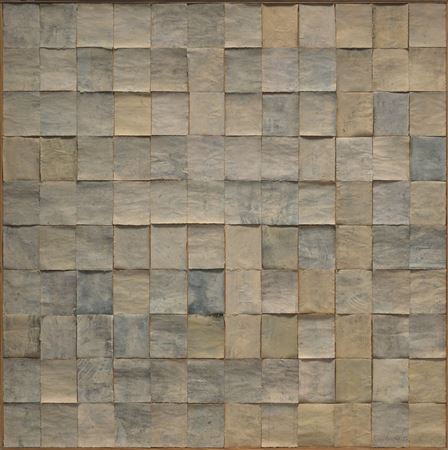
Courtright’s architectural collages, which often incorporate scraps of paper pulled directly from actual structures, dominated the artist’s oeuvre in the 1960s. These pieces eventually inspired his series of non-representational grid collages, about which he said: “I am trying to create a picture… the same way you would write a sonnet.” The artist and critic J. Bowyer Bell offered this observation of Courtright’s grids: “The real visual drama is . . . in the perception of each viewer. The grid merges into the whole, color moves across the surface, differences in intensity appear . . . an image rises from the squares, from the object. There is nothing minimal, nothing cold, nothing as exercise in the ultimate image. Each is an adventure for the eye.”
Along with short sojourns spent in New York, Courtright spent most of his career as an expatriate; he left Italy in the 1970s, settling in Opio not far from Nice in southern France. While there, he inaugurated a new body of work—masks, inspired by the Commedia dell’ Arte which he executed in marble, stone, cast bronze, and cast paper.
Courtright’s work has been exhibited internationally and is represented in the collections of the Metropolitan Museum of Art, Carnegie Institute in Pittsburgh, Aldrich Museum of Contemporary Art in Ridgefield, Connecticut, Phillips Collection in Washington, the San Francisco Museum of Modern Art, and the South Carolina Arts Commission state art collection.
The Johnson Collection, Spartanburg, South Carolina
thejohnsoncollection.orgBiography from Charlton Hall Galleries, Inc
Following is the obituary of the artist, published in The State newspaper, South Carolina, December 29, 2012
As a boy growing up in Sumter, Robert Courtright dreamed of being an artist and visiting places far beyond the town limits.
Guided by his talents, Courtright would use both of these dreams to create a world-renowned career, spreading his unique work with masks and monochromatic collages throughout the world.
The artist, painter and sculptor, who was a Sumter native, died Thursday in France, where he had lived for decades.
After studying at the Art Students League and the New School for Social Research in New York and at St. John's College in Maryland, Courtright visited Europe in 1949 before moving abroad in 1952.
Drawing from both the Mediterranean Romanesque architecture he sought out near his eventual home in southern France, and his fascination with Commedia dell' Arte, Courtright embarked on a career of more than 60 years.
"I've always been terrifically influenced by Italian 14th and 15th century artists, but there are very few artists I don't find interesting," Courtright said in a 1983 interview with The (Sumter) Item newspaper, while also pointing out he tried to create his art by allowing the work to take over the effort, rather than trying to impose a theme.
"I am trying to create a picture, the same way you would write a sonnet," Courtright said.
The 1943 graduate of Sumter High School first gained attention for what he liked to call his "collage constructions." In these works, layers of materials such as French paper, special marble paste, cotton rag paper and acrylic are held together loosely to create a floating effect. Found materials also were popular for Courtright's collages.
In the 1970s, Courtright began to turn his attention toward creating artistic masks, which he said was first inspired by a set of dime-store French carnival masks he spotted in Nice, finding them both haunting and engrossing.
This led to acclaimed exhibitions in New York and Paris, before spreading throughout the world.
Courtright's work is currently represented in the collections of the Metropolitan Museum of Art, Carnegie Institute and San Francisco Museum of Modern Art, among others.
During his long career, Courtright had ongoing gallery representation in New York, Paris and other cities.
Courtright has remained close to old acquaintances in South Carolina, and in recent years made new friends and fans in his home state.
For South Carolinians, Courtright's acclaimed work was best displayed in 2009, when one of the largest and most comprehensive exhibitions of his work ever mounted - "Robert Courtright: Collages, Collage Constructions and Masks 1953-2008" - was held at the South Carolina State Museum.
The retrospective show featured more than 100 pieces, from early collages and masks to new constructions made specifically for the exhibition. It was on display for six months, offering South Carolinians a rare look at Courtright's work.
"With this exhibit he returned to his home state to bring back part of what he learned in other parts of the world, combined with the parts of South Carolina culture he took into the world with him," the museum's chief curator of art, Paul Matheny, said at the time.
Recognizable images in his collages gave way in the 1960s to more abstract work, which remained the core of his art.
His collages usually are grids of colored paper, each lightly attached to a support rather than overlapping as in traditional collage. Although these pieces are monochromatic, each piece of paper has color and texture variations.
Some collages are made of recycled paper, some bleached out but at times giving glimpses of their previous incarnations. Some newer works involve heavier, high-grade paper that has been painted, sanded and painted again.
"I think his collage work is directly related to the whole tradition of abstract painting," Pavel Zoubok of the Pavel Zoubok Gallery, Courtright's gallery in New York, told The State newspaper in February 2009.
"What's interesting about his work is that we usually don't associate collage with reductive or minimalist aesthetics."
Courtright created three large pieces - among the biggest he ever made - specifically for the State Museum show.
After helping install the work and attending the opening reception, he headed to Edisto Beach, where he had gone since he was a kid, to make more art.
By BRADEN BUNCH — bbunch@theitem.com
State staffers contributed to this report.