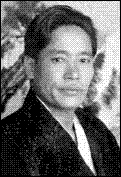
Born in the Okayama prefecture of Japan, Chiura Obata was adopted by his uncle, an artist. As a child he was trained in ink painting, and at 14 he was apprenticed to the painter Murata Tanryo in... Read full biography
Born in the Okayama prefecture of Japan, Chiura Obata was adopted by his uncle, an artist. As a child he was trained in ink painting, and at 14 he was apprenticed to the painter Murata Tanryo in Tokyo. He also studied with Kogyo Terasaki and Goho Hasimoto. In 1903, Obata moved to San Francisco and... Read full biography
Born in the Okayama prefecture of Japan, Chiura Obata was adopted by his uncle, an artist. As a child he was trained in ink painting, and at 14 he was apprenticed to the painter Murata Tanryo in Tokyo. He also studied with Kogyo Terasaki and Goho Hasimoto. In 1903, Obata moved to San Francisco and began working as an illustrator for The New World and The Japanese American, two of the city's Japanese newspapers. He also did work as a commercial designer. Obata helped establish the East West Art... Read full biography
Born in the Okayama prefecture of Japan, Chiura Obata was adopted by his uncle, an artist. As a child he was trained in ink painting, and at 14 he was apprenticed to the painter Murata Tanryo in Tokyo. He also studied with Kogyo Terasaki and Goho Hasimoto. In 1903, Obata moved to San Francisco and began working as an illustrator for The New World and The Japanese American, two of the city's Japanese newspapers. He also did work as a commercial designer. Obata helped establish the East West Art Society in San Francisco in 1921, which sought to promote cross-cultural understanding through art. This goal was reflected in his embrace of the Nihonga style, which fused traditional Japanese sumi-e ink painting with the conventions of western... Read full biography
Born in the Okayama prefecture of Japan, Chiura Obata was adopted by his uncle, an artist. As a child he was trained in ink painting, and at 14 he was apprenticed to the painter Murata Tanryo in Tokyo. He also studied with Kogyo Terasaki and Goho Hasimoto. In 1903, Obata moved to San Francisco and began working as an illustrator for The New World and The Japanese American, two of the city's Japanese newspapers. He also did work as a commercial designer. Obata helped establish the East West Art Society in San Francisco in 1921, which sought to promote cross-cultural understanding through art. This goal was reflected in his embrace of the Nihonga style, which fused traditional Japanese sumi-e ink painting with the conventions of western naturalism. He spent much of the 1920s painting landscapes throughout California, and among his... Read full biography
Chiura Obata - Artist Info
About Chiura Obata: Books
Books & Publications (32)
Publications based on askART research. List may not be comprehensive.
Treasured Landscapes: National Park Service Art Collections Tell America's Stories (National Park Service)
2016
Bacharach, Joan (General Editor)
160 pages (color)
Mountains and Rivers Without End: Poem by
2008
Snyder, Gary
0 pages (color)
Yosemite: Art of an American Icon (Exhibition catalog)
2006
Scott, Amy (Editor); Brian Bibby, William Deverell, et all
221 pages (color)
Past Tents: The Way We Camped
2006
Snyder, Susan
0 pages (color)
The Artists Bluebook 34,000 North American Artists to March 2005
2005
AskART.com Inc. - Dunbier, Lonnie Pierson (Editor)
479 pages
Masterworks of American Painting at the De Young (De Young Museum)
2005
Burgard, Timothy Anglin; Daniell Cornell
573 pages (color)
Davenport's Art Reference: The Gold Edition
2005
Davenport, Ray
2,421 pages
Being Japanese American: A JA Sourcebook for Nikkei, Hapa . . . and Their Friends
2004
Asakawa, Gil
0 pages (color)
Journey To Topaz: A Story Of The Japanese-American Evacuation
2004
Carrick, Donald and Uchida, Yoshiko
0 pages (color)
Art Against the Odds: From Slave Quilts to Prison Paintings
2004
Goldman Rubin, Susan
0 pages (color)
Last Witnesses: Reflections on the Wartime Internment of Japanese Americans
2003
Harth, Erica
0 pages (color)
Extraordinary Asian Americans and Pacific Islanders (Extraordinary People)