Page loaded successfully. Showing keywords for Chiura Obata.
Artist Keywords
Keywords page for Chiura Obata ((1885 - 1975)), known for Portrait, modernist landscape, and still life painting. Showing associated keywords and tags.
Chiura Obata KEYWORDS
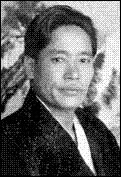
1885 Sendai, Japan - 1975 Berkeley, California. Known for: Portrait, modernist landscape, and still life painting.
Born in the Okayama prefecture of Japan, Chiura Obata was adopted by his uncle, an artist. As a child he was trained in ink painting, and at 14 he was apprenticed to the painter Murata Tanryo in... Read full biography
Born in the Okayama prefecture of Japan, Chiura Obata was adopted by his uncle, an artist. As a child he was trained in ink painting, and at 14 he was apprenticed to the painter Murata Tanryo in Tokyo. He also studied with Kogyo Terasaki and Goho Hasimoto. In 1903, Obata moved to San Francisco and... Read full biography
Born in the Okayama prefecture of Japan, Chiura Obata was adopted by his uncle, an artist. As a child he was trained in ink painting, and at 14 he was apprenticed to the painter Murata Tanryo in Tokyo. He also studied with Kogyo Terasaki and Goho Hasimoto. In 1903, Obata moved to San Francisco and began working as an illustrator for The New World and The Japanese American, two of the city's Japanese newspapers. He also did work as a commercial designer. Obata helped establish the East West Art... Read full biography
Born in the Okayama prefecture of Japan, Chiura Obata was adopted by his uncle, an artist. As a child he was trained in ink painting, and at 14 he was apprenticed to the painter Murata Tanryo in Tokyo. He also studied with Kogyo Terasaki and Goho Hasimoto. In 1903, Obata moved to San Francisco and began working as an illustrator for The New World and The Japanese American, two of the city's Japanese newspapers. He also did work as a commercial designer. Obata helped establish the East West Art Society in San Francisco in 1921, which sought to promote cross-cultural understanding through art. This goal was reflected in his embrace of the Nihonga style, which fused traditional Japanese sumi-e ink painting with the conventions of western... Read full biography
Born in the Okayama prefecture of Japan, Chiura Obata was adopted by his uncle, an artist. As a child he was trained in ink painting, and at 14 he was apprenticed to the painter Murata Tanryo in Tokyo. He also studied with Kogyo Terasaki and Goho Hasimoto. In 1903, Obata moved to San Francisco and began working as an illustrator for The New World and The Japanese American, two of the city's Japanese newspapers. He also did work as a commercial designer. Obata helped establish the East West Art Society in San Francisco in 1921, which sought to promote cross-cultural understanding through art. This goal was reflected in his embrace of the Nihonga style, which fused traditional Japanese sumi-e ink painting with the conventions of western naturalism. He spent much of the 1920s painting landscapes throughout California, and among his... Read full biography
Chiura Obata - Artist Info
About Chiura Obata: Keywords
Keywords (38)
Art Method
- •Airbrush
- •Easel Painting
- •Graphic Design, Printmaking, Lithography, Etching, Woodblocks
- •Illustration, Illustrator
- •Nihonga: Japanese Mineral Pigment Painting
Art Media
Art Style
- •Folk Art, Naive, Primitive
- •Modernist, Modernism (Partially Abstract, Leading Edge)
- •Naive, Childlike, Intuitive
- •Sophisticated Naive, Primitive
Art Subject
- •Figure, Figurative Humans
- •Landscape, Nature, Rural Scene
- •Marine, Maritime, Riverfront, Boats, Canoes, Steam Boats, Nautical
- •Portraits, Portraiture
- •Still Life
- •Urban Scene, City Genre
Geography/Places Lived and/or Worked
- •Asia, Orient
- •California Before 1940
- •Grand Canyon, Arizona
- •Japan
- •Yosemite National Park
Art Association
- •California Art Club-
- •California Watercolor Society
Art School
- •Tanforan Art School for Japanese, California, Teacher
- •Topaz Art School for Japanese Internees, Teacher
Chronology
- •Early 20th Century Before 1950
- •Late 20th Century After 1950
Added Description
- •Art Educator:Teaching, Scholarship, Workshops and/or Writing
- •In Japanese Internment Camp, USA World War II
Ethnicity of Artist
- •Asian
- •Japanese
Exhibition of Art Association
- •California Watercolor Society-
- •San Francisco Art Association
Exhibition of Museum
- •Art Institute of Chicago
Exhibition By An Art School
- •The Pennsylvania Academy of the Fine Arts