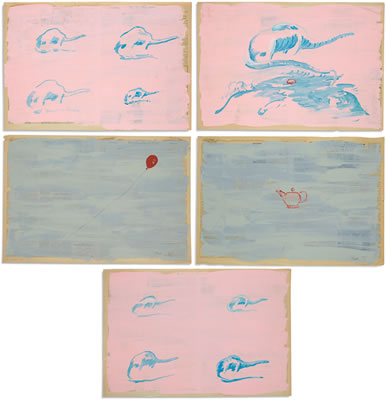
The following review, by Holland Cotter, is from The New York Times, October 21, 2010. Paul Thek, the subject of a ragged, moving and much-anticipated retrospective at the Whitney Museum of American... Read full biography
The following review, by Holland Cotter, is from The New York Times, October 21, 2010. Paul Thek, the subject of a ragged, moving and much-anticipated retrospective at the Whitney Museum of American Art, was only 54 when he died of AIDS in 1988. But by then he had already slipped through the cracks... Read full biography
The following review, by Holland Cotter, is from The New York Times, October 21, 2010. Paul Thek, the subject of a ragged, moving and much-anticipated retrospective at the Whitney Museum of American Art, was only 54 when he died of AIDS in 1988. But by then he had already slipped through the cracks of art history. Or rather he had fallen into one of the deep trenches that divide that history into artificial islands with names like Pop and Minimalism. Thek came to art with so much going for him... Read full biography
The following review, by Holland Cotter, is from The New York Times, October 21, 2010. Paul Thek, the subject of a ragged, moving and much-anticipated retrospective at the Whitney Museum of American Art, was only 54 when he died of AIDS in 1988. But by then he had already slipped through the cracks of art history. Or rather he had fallen into one of the deep trenches that divide that history into artificial islands with names like Pop and Minimalism. Thek came to art with so much going for him — talent, looks, energy and imaginative peculiarity — that for a decade or so he was an island unto himself, an archipelago even. In the early 1960s, when everyone else in New York was into hands-off fabrication and Benday dots, he was modeling... Read full biography
The following review, by Holland Cotter, is from The New York Times, October 21, 2010. Paul Thek, the subject of a ragged, moving and much-anticipated retrospective at the Whitney Museum of American Art, was only 54 when he died of AIDS in 1988. But by then he had already slipped through the cracks of art history. Or rather he had fallen into one of the deep trenches that divide that history into artificial islands with names like Pop and Minimalism. Thek came to art with so much going for him — talent, looks, energy and imaginative peculiarity — that for a decade or so he was an island unto himself, an archipelago even. In the early 1960s, when everyone else in New York was into hands-off fabrication and Benday dots, he was modeling hyper-realistic images of meat, raw and bleeding, from beeswax. Gross and funny, they had people buzzing.... Read full biography
Paul Thek - Artist Info
About Paul Thek: Books
Books & Publications (18)
Publications based on askART research. List may not be comprehensive.
Paul Thek: Artist's Artist
2008
Falckenberg, Harald; Peter Weibel
550 pages (color)
The Artists Bluebook 34,000 North American Artists to March 2005
2005
AskART.com Inc. - Dunbier, Lonnie Pierson (Editor)
479 pages
Davenport's Art Reference: The Gold Edition
2005
Davenport, Ray
2,421 pages
Who Was Who in American Art, 1564-1975: Three Volumes
1999
Falk, Peter Hastings (Editor)
3,724 pages
Hirshhorn Museum and Sculpture Garden 195 Works of Art
1996
Demetrion, James T (Introduction)
166 pages (color)
Word As Image American Art 1960-1990 (Exhibition catalog)
1990
Bowman, Russell/Dean Sobel
172 pages (color)
Contemporary Artists (3rd Edition)
1989
Naylor, Colin (editor)
1,059 pages
Dictionary of Contemporary American Artists (5th Edition)
1987
Cummings, Paul
653 pages
Who's Who in American Art-1986 1986
1986
Jaques Cattell Press
1,292 pages
Movements in Art since 1945 New Revised Edition
1984
Lucie-Smith, Edward
288 pages (color)
Critical Vision/A Historyof Social and Political Art in the U S
1982
Von Blum, Paul
165 pages
The Oxford Companion to Twentieth Century Art
1981
Osborne, Harold
656 pages (color)
Art in the Seventies
1980
Lucie-Smith, Edward
128 pages (color)
American Sculpture A Guide to Information Sources
1977
Ekdahl, Janis
260 pages
Art on the Edge Creators and Situations
1975
Rosenberg, Harold
303 pages
The New Humanism Art in a Time of Change
1974
Schwartz, Barry
192 pages (color)
Human Concern/Personal Torment The Grotesque in American Art (Exhibition catalog)