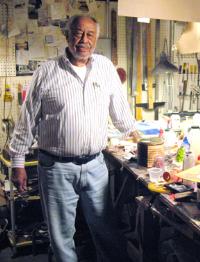
PHILLIP JEWEL HAMPTON (1922-2016). The premise that black artists should represent black life was fairly prevalent in the United States before the middle of the twentieth century. This was the path... Read full biography
PHILLIP JEWEL HAMPTON (1922-2016). The premise that black artists should represent black life was fairly prevalent in the United States before the middle of the twentieth century. This was the path that Phillip Jewel Hampton pursued in his early paintings of ramshackle cityscapes, leading to his... Read full biography
PHILLIP JEWEL HAMPTON (1922-2016). The premise that black artists should represent black life was fairly prevalent in the United States before the middle of the twentieth century. This was the path that Phillip Jewel Hampton pursued in his early paintings of ramshackle cityscapes, leading to his association with social realist trends of the 1930s. But after two decades he was a full-fledged abstractionist—a stylistic move made by many artists during the 1940s and 1950s–who experimented with... Read full biography
PHILLIP JEWEL HAMPTON (1922-2016). The premise that black artists should represent black life was fairly prevalent in the United States before the middle of the twentieth century. This was the path that Phillip Jewel Hampton pursued in his early paintings of ramshackle cityscapes, leading to his association with social realist trends of the 1930s. But after two decades he was a full-fledged abstractionist—a stylistic move made by many artists during the 1940s and 1950s–who experimented with synthetic media. A native of Kansas City, Missouri, Hampton displayed an early interest in art and, to the dismay of family members, used window blinds for his formative art making. His childhood was disrupted by yearly moves between 1929 and 1941. He... Read full biography
PHILLIP JEWEL HAMPTON (1922-2016). The premise that black artists should represent black life was fairly prevalent in the United States before the middle of the twentieth century. This was the path that Phillip Jewel Hampton pursued in his early paintings of ramshackle cityscapes, leading to his association with social realist trends of the 1930s. But after two decades he was a full-fledged abstractionist—a stylistic move made by many artists during the 1940s and 1950s–who experimented with synthetic media. A native of Kansas City, Missouri, Hampton displayed an early interest in art and, to the dismay of family members, used window blinds for his formative art making. His childhood was disrupted by yearly moves between 1929 and 1941. He entered Citrus Junior College in Glendora, California, and majored in art, until he was inducted into the United States Army in 19... Read full biography
Phillip Jewel Hampton - Artist Info
About Phillip Jewel Hampton: Books
Books & Publications (11)
Publications based on askART research. List may not be comprehensive.
The Artists Bluebook 34,000 North American Artists to March 2005
2005
AskART.com Inc. - Dunbier, Lonnie Pierson (Editor)
479 pages
Davenport's Art Reference: The Gold Edition
2005
Davenport, Ray
2,421 pages
Who's Who in American Art, 2004 2003 - 2004 (25th Edition)
2004
McGowan, Alison C (Editor)
1,512 pages
Who Was Who in American Art, 1564-1975: Three Volumes
1999
Falk, Peter Hastings (Editor)
3,724 pages
Who's Who in American Art, 1997-1998
1997
Marquis Who's Who
1,515 pages
Who's Who in American Art, 1993-1994, 20th Edition (American Federation of Arts)
1993
Bowker R R
1,473 pages
Who's Who in American Art-1986 1986
1986
Jaques Cattell Press
1,292 pages
Who's Who in American Art, 1976 12th Edition
1976
Jaques Cattell Press
756 pages
Afro-American Artists: A Bio-Bibliographical Directory