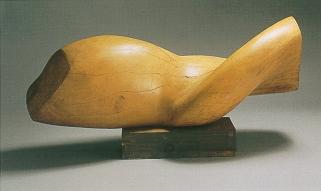
Of Raoul Hague, it was written that he "had two insatiable loves: the human figure and the materials he carved. They come together with remarkable clarity" . in his torsos whose titles often have the... Read full biography
Of Raoul Hague, it was written that he "had two insatiable loves: the human figure and the materials he carved. They come together with remarkable clarity" . in his torsos whose titles often have the type of wood used. ((Reynolds 252) . In his massive wooden sculptures of the human figure, Raoul... Read full biography
Of Raoul Hague, it was written that he "had two insatiable loves: the human figure and the materials he carved. They come together with remarkable clarity" . in his torsos whose titles often have the type of wood used. ((Reynolds 252) . In his massive wooden sculptures of the human figure, Raoul Hague reflected his understanding that the tree is a living body with a pattern of growth and individual expression. Like humans they are vulnerable to environmental problems and can have long life... Read full biography
Of Raoul Hague, it was written that he "had two insatiable loves: the human figure and the materials he carved. They come together with remarkable clarity" . in his torsos whose titles often have the type of wood used. ((Reynolds 252) . In his massive wooden sculptures of the human figure, Raoul Hague reflected his understanding that the tree is a living body with a pattern of growth and individual expression. Like humans they are vulnerable to environmental problems and can have long life spans. He said: "I cut the mass into fragments and I move in it. One can orchestrate in the wood---I don't have a clear idea when I start . So you begin. You stare at it, and finally you have to do something. You make a cut. From then on it follows."... Read full biography
Of Raoul Hague, it was written that he "had two insatiable loves: the human figure and the materials he carved. They come together with remarkable clarity" . in his torsos whose titles often have the type of wood used. ((Reynolds 252) . In his massive wooden sculptures of the human figure, Raoul Hague reflected his understanding that the tree is a living body with a pattern of growth and individual expression. Like humans they are vulnerable to environmental problems and can have long life spans. He said: "I cut the mass into fragments and I move in it. One can orchestrate in the wood---I don't have a clear idea when I start . So you begin. You stare at it, and finally you have to do something. You make a cut. From then on it follows." (Herskovic 154). Hague spent most of his working life in Woodstock, New York where he died in 1993 at age 88. His close friends we... Read full biography
Raoul Hague - Artist Info
About Raoul Hague: Books
Books & Publications (34)
Publications based on askART research. List may not be comprehensive.
The Artists Bluebook 34,000 North American Artists to March 2005
2005
AskART.com Inc. - Dunbier, Lonnie Pierson (Editor)
479 pages
Davenport's Art Reference: The Gold Edition
2005
Davenport, Ray
2,421 pages
American Abstract Expressionism of the 1950s: An Illustrated Survey
2003
Herskovic, Marika (editor)
372 pages (color)
Who Was Who in American Art, 1564-1975: Three Volumes
1999
Falk, Peter Hastings (Editor)
3,724 pages
The Art Students League of New York: A History (Students)
1999
Steiner, Raymond J
187 pages
Sculpture An Illustrated Catalogue (Exhibition catalog)
1994
National Gallery of Art
283 pages
Masters of American Sculpture: The Figurative Tradition From the American Renaissance to the Millenium
1994
Reynolds, Donald Martin
275 pages (color)
Who's Who in American Art, 1993-1994, 20th Edition (American Federation of Arts)