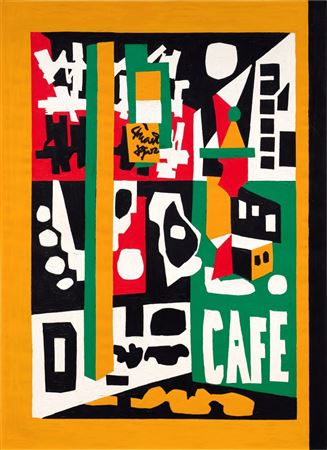
Born in Philadelphia in 1892, Stuart Davis is known by many art historians as the American painter most influenced by Cubism. Art historian Norman Geske described Davis' career as a "near classical... Read full biography
Born in Philadelphia in 1892, Stuart Davis is known by many art historians as the American painter most influenced by Cubism. Art historian Norman Geske described Davis' career as a "near classical demonstration of the process by which American painting of the twentieth century came of age." (40).... Read full biography
Born in Philadelphia in 1892, Stuart Davis is known by many art historians as the American painter most influenced by Cubism. Art historian Norman Geske described Davis' career as a "near classical demonstration of the process by which American painting of the twentieth century came of age." (40). Davis moved from journalistic illustration to Social Realism, to Expressionism, to Cubism, ultimately becoming one of America's leading abstractionists. Strongly influenced by Fernand Leger and the... Read full biography
Born in Philadelphia in 1892, Stuart Davis is known by many art historians as the American painter most influenced by Cubism. Art historian Norman Geske described Davis' career as a "near classical demonstration of the process by which American painting of the twentieth century came of age." (40). Davis moved from journalistic illustration to Social Realism, to Expressionism, to Cubism, ultimately becoming one of America's leading abstractionists. Strongly influenced by Fernand Leger and the New York Armory Show of 1912, he developed his own unique style of Cubism, which also incorporated Realism. Along with Max Weber, he is credited with being the importer of Cubism to the United States from France at a time when the public was more... Read full biography
Born in Philadelphia in 1892, Stuart Davis is known by many art historians as the American painter most influenced by Cubism. Art historian Norman Geske described Davis' career as a "near classical demonstration of the process by which American painting of the twentieth century came of age." (40). Davis moved from journalistic illustration to Social Realism, to Expressionism, to Cubism, ultimately becoming one of America's leading abstractionists. Strongly influenced by Fernand Leger and the New York Armory Show of 1912, he developed his own unique style of Cubism, which also incorporated Realism. Along with Max Weber, he is credited with being the importer of Cubism to the United States from France at a time when the public was more interested in Social Realism and American Scene painting with people and places that were recognizable. Through his... Read full biography
Stuart Davis - Artist Info
About Stuart Davis: Books
Books & Publications (414)
Publications based on askART research. List may not be comprehensive.
Works on Paper from the Collection of the Sheldon Museum of Art
2016
Rudd, Brandon and Gregory Nosan, Editors; Wally Mason, Director's Mewssage
312 pages (color)
A Legacy of Giving: The Anna and Frank Hall Collection (The Sheldon Museum of Art, University of Nebraska, Lincoln) (Exhibition catalog)
2012
Embury, Stuart; Brandon K. Ruud; Norman Geske; Jorge Daniel Veneciano, Introduction
80 pages (color)
Light, Landscape and the Creative Quest: Early Artists of Santa Fe
2012
Lewandowski, Stacia
272 pages (color)
Dynamic Impulse The Drawings of Stuart Davis (Exhibition catalog)
2008
Birmingham, Mary (Hollis Taggart Galleries)
96 pages (color)
Stuart Davis: A Catalogue Raisonné (3 Volume Set)
2007
Boyajian, Ani; Mark Rutkoski
0 pages (color)
The Girl With the Gallery: Edith Gregor Halpert and the Making of the Modern Art Market
2006
Pollock, Lindsay
483 pages (color)
The Guide to the Art of Rockefeller Center
2006
Roussel, Christine
159 pages (color)
Santa Fe Art Colony: Gerald Peters Gallery (Exhibition catalog)
2006
Udall, Sharyn R; Julie Schimmel (Introduction)
127 pages (color)
The Artists Bluebook 34,000 North American Artists to March 2005
2005
AskART.com Inc. - Dunbier, Lonnie Pierson (Editor)
479 pages
Davenport's Art Reference: The Gold Edition
2005
Davenport, Ray
2,421 pages
American Modernism from the Kauffman Collection (Exhibition catalog)
2003
Blazier, Wendy M
146 pages (color)
An American Point of View The Daniel J. Terra Collection (Exhibition catalog)
2002
Kennedy and Bourguignon(essays
194 pages (color)
Phoenix Art Museum Collection Highlights
2002
Komanecky, Michael K. (editor)
352 pages (color)
Writers on Artists
2001
Byatt, A.S. (foreward)
352 pages (color)
Inheriting Cubism: The Impact of Cubism on American Art, 1909-1936 Hollis Taggart Galleries (Exhibition catalog)
2001
Cauman, John (Essay); Stacey B. Epstein (Intro)
0 pages (color)
American Paintings from the Sheldon Memorial Art Gallery: An Institutional History in Pictures (Exhibition catalog)
2001
Siedell, Daniel A.
9 pages (color)
Life of the People: Realist Prints and Drawings from the Ben and Beatrice Goldstein Collection, 1912 to 1948 (Exhibition catalog)
2000
McCoy, Garnett; B Reilly Jr. and Harry L. Katz, Editor
120 pages (color)
Painters and the American West: The Anschutz Collection
2000
Troccoli, Joan Carpenter
218 pages (color)
Select Works: Fine American and European Paintings (Exhibition catalog)
1999
Caldwell, Joseph S III & IV
20 pages (color)
Who Was Who in American Art, 1564-1975: Three Volumes
1999
Falk, Peter Hastings (Editor)
3,724 pages
Carl W Peters: American Scene Painter from Rochester
1999
Love, Richard H
927 pages (color)
The Eye of Duncan Phillips A Collection in the Making
1999
Passantino, Erika D (editor)
819 pages (color)
The Art Students League of New York A History (Teachers)
1999
Steiner, Raymond J
0 pages
Critical Issues in American Art A Book of Readings
1998
Calo, Mary Ann
328 pages
Modern American Painting 1910-194 Toward A New Perspective (Exhibition catalog)
1997
Agee, William C
24 pages
The American Fauves: The Color of Modernism (Exhibition catalog)
1997
Gerdts, William H; Hollis Taggart
159 pages (color)
American Visions The Epic History of Art in America
1997
Hughes, Robert
635 pages (color)
Visual Arts in the 20th Century
1997
Lucie-Smith, Edward
400 pages (color)
Twentieth Century Still Life Paintings from Phillips Collection
1997
Phillips, Stephen Bennett
120 pages (color)
Objects of Desire The Modern Still Life (Exhibition catalog)
1997
Rowell, Margit
232 pages (color)
Addison Gallery of American Art 65 Years A Selective Catalogue (Exhibition catalog)
1996
Addison Gallery
512 pages (color)
Accents on Artists A fact-filled pronunciation guide. Over 800 artist’s names you should know…
1996
Barbara and Peter Toohil
363 pages (color)
Hirshhorn Museum and Sculpture Garden 195 Works of Art
1996
Demetrion, James T (Introduction)
166 pages (color)
Stuart Davis
1996
Hills, Patricia
160 pages (color)
American Images/The SBC Collection of 20th Century American Art
1996
Hopps, Walter (others)
320 pages (color)
American Paintings Before 1945 in the Wadsworth Atheneum (2 Vols)
1996
Kornhauser, Elizabeth Mankin
877 pages (color)
Making Mischief Dada Invades New York (Exhibition catalog)
1996
Naumann, Francis/Beth Venn
304 pages (color)
American Art Colonies 1850-1930 A Guide to Original Art Colonies and Their Artists
1996
Shipp, Steve
159 pages
Still Life The Object in American Art, 1915-1995 (Exhibition catalog)
1996
Sims, Lowery/Sabine Rewald
175 pages (color)
City of Ambition Artists and New York, 1900-1960 (Exhibition catalog)
1996
Sussman, Elizabeth
144 pages (color)
The Art Institute of Chicago Twentieth Century Painting and Sculpture
1996
Wood, James N/T Edelstein
160 pages (color)
To Be Modern American Encounters with Cezanne and Company (Exhibition catalog)
1996
Yount, Sylvia/Elizabeth Johns
80 pages (color)
Made in America Ten Centuries of American Art
1995
Adams, H. and Johnson, K.
192 pages (color)
Advertising, Artists & the Borders of Art
1995
Bogart, Michelle H
427 pages
Drawing the Line Reappraising Drawing Past and Present (Exhibition catalog)
1995
Craig-Martin, Michael
108 pages (color)
Views from Abroad European Perspectives on American Art (Exhibition catalog)
1995
Fuchs, Rudi/Adam D Weinberg
127 pages (color)
Art as Expression
1995
Peacock, Henry W
232 pages (color)
American Art History and Culture
1994
Craven, Wayne
687 pages (color)
Paintings of the Southwest
1994
Skolnick, Arnold/Suzan Campbell
128 pages
Precisionism in America 1915-1941 Reordering Reality (Exhibition catalog)
1994
Stavitsky, Gail; Ellen Handy, Miles Orvell et all
160 pages (color)
Master Paintings from the Butler Institute of American Art
1994
Sweetkind, Irene/W H Gerdts
372 pages (color)
Clement Greenberg: The Collected Essays and Criticism (4 Volumes)
1993
Greenberg, Clement; Dr. John O'Brian, Editor
622 pages
Themes in American Painting Common Styles and Genres/A Reference
1993
Henkes, Robert
260 pages (color)
American Art in the 20th Century Painting and Sculpture 1913-1993 (Exhibition catalog)
1993
Joachimides, Christos (others)
490 pages (color)
Dictionary of the Avant-Gardes
1993
Kostelanetz, Richard
246 pages
Awash in Color Homer, Sargent and the Great American Watercolor (Exhibition catalog)
1993
Reed, Sue Welsh/Carol Troyen
266 pages (color)
Raiding the Icebox Reflections on Twentieth-Century Culture
1993
Wollen, Peter
222 pages
American Art Paintings from the Amon Carter Museum
1992
Cash, Sarah
59 pages (color)
A Nation's Legacy 150 Years of American Art from Ohio Collections (Exhibition catalog)
1992
Columbus Museum of Art
198 pages (color)
Transforming the Western Image in 20th Century American Art (Exhibition catalog)
1992
Hough, Katherine
111 pages (color)
The Drawings of Stuart Davis The Amazing Continuity (Exhibition catalog)
1992
Wilkin, Karen/Lewis Kachur
143 pages (color)
Modernism in Dispute Art Since the Forties
1992
Wood, Paul (others)
267 pages (color)
Cleveland Museum of Art Handbook (of the Collection)
1991
Cleveland Museum of Art
161 pages
West West West Major Paintings from the Anschutz Collection
1991
Cunningham, Elizabeth
131 pages (color)
Benton, Pollock and the Politics of Modernism
1991
Doss, Erika
445 pages
Abstract Expressionism and the Modern Experience
1991
Polcari, Stephen
408 pages (color)
Stuart Davis American Painter
1991
Sims, Lowery Stokes
333 pages (color)
Brandywine Valley to the Bay Art from Private Collections (Exhibition catalog)
1991
University Gallery-Delaware
161 pages (color)
Strange Bedfellows: The First American Avant-Garde
1991
Watson, Steven
439 pages (color)
A Spectrum of Innovation Color in American Printmaking 1890-1960 (Exhibition catalog)
1990
Acton, David
304 pages (color)
Annual Exhibition Record, National Academy of Design: 1901-1950 (Exhibition catalog)
1990
Falk, Peter Hastings
622 pages
The Annual Exhibition Record of the Art Institute of Chicago (Exhibition catalog)
1990
Falk, Peter Hastings (Editor)
1,117 pages
Art Across America: New England, New York, Mid-Atlantic (Volume One)
1990
Gerdts, William H
421 pages (color)
American Painting
1990
Goddard, Donald; Robert Rosenblum (Intro)
319 pages (color)
Counterpoint Two Centuries of American Masters (Exhibition catalog)
1990
Hirschl & Adler Galleries
112 pages (color)
Pop Art A Continuing History
1990
Livingstone, Marco
271 pages (color)
American Art/American Vision Paintings from a Century of Collecting (Exhibition catalog)
1990
Schall, Ellen (others)
164 pages (color)
Abstract Expressionism
1990
Shapiro, David and Cecile
442 pages
High and Low Modern Art/Popular Culture (Exhibition catalog)
1990
Varnedoe, Kirk/Adam Gopnik
460 pages (color)
Art in Place Fifteen Years of Acquisition (Exhibition catalog)
1989
Armstrong, Tom/Susan C Larsen
230 pages (color)
Annual Exhibition Record, 1914-68, Pennsylvania Academy of the Fine Arts (Exhibition catalog)
1989
Falk, Peter Hastings (Editor)
538 pages
The American Paintings (in the) Pennsylvania Academy of Fine Art
1989
Fresella-Lee, Nancy
222 pages (color)
Artists in Quotation Dictionary of Creative Thoughts of Painters etc
1989
La Cour, Donna Ward
196 pages
The Story of Modern Art
1989
Lynton, Norbert
400 pages (color)
A Permanent Legacy Museum of Fine Arts, Houston (150 Works)
1989
Marzio, Peter C (intro)
366 pages (color)
Sounding the Depths 150 Years of American Seascape
1989
Nelson, Harold B
111 pages (color)
Antifascism in American Art
1989
Whiting, Cecile
238 pages
Stuart Davis (1892-1964) Motifs and Versions (Exhibition catalog)
1988
Agee, William/L B Salander
108 pages (color)
The American Collections Columbus Museum of Art
1988
Columbus Museum of Art
271 pages (color)
Twentieth Century Watercolors
1988
Finch, Christopher
310 pages (color)
The American Painting Collection of the Sheldon Memorial Art Gallery
1988
Geske, Norman and Karen O. Janovy
376 pages (color)
American Masterworks on Paper 1800-1960
1988
Susan Sheehan Inc
104 pages
Master Paintings in the Art Institute of Chicago
1988
Wood, James N/Katherine Lee
168 pages (color)
Collected Essays on 101 Art Works From the Permanent Collection, Wichita Art Musem
1988
Wooden, Howard E
212 pages
Art for the Masses A Radical Magazine and its Graphics 1911-1917 (Exhibition catalog)
1988
Zurier, Rebecca
217 pages
Stuart Davis The Breakthrough Years (1922-1924) (Exhibition catalog)
1987
Agee, William C
40 pages (color)
American Drawings and Watercolors from the Wadsworth Atheneum
1987
Barter, Judith A; Eugene R. Gaddis (Intro)
94 pages (color)
Dictionary of Contemporary American Artists (5th Edition)
1987
Cummings, Paul
653 pages
20th Century Drawings from the Whitney Museum of American Art
1987
Cummings, Paul
176 pages (color)
Varieties of Visual Experience (3rd edition)
1987
Feldman, Edmund Burke
528 pages (color)
Summits II/Etchings of John Sloan Two Concurrent Exhibitions (Exhibition catalog)
1987
Fleischman, Lawrence
82 pages (color)
Whistler to Weidenaar American Prints 1870-1950 (Exhibition catalog)
1987
Johnson, Deborah J
128 pages
Twentieth Century American Painting Thyssen-Bornemisza Collection
1987
Levin, Gail
407 pages (color)
Modern American Realism The Sara Roby Foundation Collection (Exhibition catalog)
1987
Mecklenburg, Virginia
148 pages (color)
A Proud Heritage Two Centuries of American Art
1987
Neff, Terry (editor)
300 pages (color)
American Printmakers: 1860-1950
1987
R.S. Johnson Fine Art
119 pages
The Ebsworth Collection: American Modernism, 1911-1947
1987
Saint Louis Art Museum
225 pages (color)
125 Masterpieces: From the Collection of Albright-Knox
1987
Schultz, Douglas (Intro)
264 pages (color)
Made In U S A An Americanization in Modern Art '50s & 60s (Exhibition catalog)
1987
Stich, Sidra
280 pages (color)
Stuart Davis
1987
Wilkin, Karen
247 pages (color)
America: Art and the West (Australian exhibition) (Exhibition catalog)
1986
Adams, Celeste Marie
130 pages (color)
Artists Against War and Fascism Papers/First American Artists' Congress
1986
Baigell, Mathew/Julia Williams
310 pages
The Figure in American Art 1764-1983 Three Simultaneous Exhibitions: Kennedy Galleries (Exhibition catalog)
1986
Baur, John I.H.
72 pages (color)
Stuart Davis Sketchbooks
1986
Davis, Stuart and Earl
132 pages
50 Years Ago: WPA/AAA
1986
Editor, Washburn Gallery
32 pages (color)
Art in New Mexico, 1900-1945 Paths to Taos and Santa Fe
1986
Eldredge, Charles/J Schimmel
218 pages (color)
American Watercolors
1986
Finch, Christopher
312 pages (color)
Insights & Outlooks American 20th Century Watercolors & Drawings (Exhibition catalog)
1986
Fleischman, Martha (Intro)
36 pages
An American Renaissance Painting and Sculpture Since 1940 (Exhibition catalog)
1986
Hunter, Sam
269 pages (color)
The Sturman Collection Twentieth-Century Works on Paper (Exhibition catalog)
1986
Karp, Ivan (intro)
44 pages (color)
The Advent of Modernism Post-Impressionism...1900-1918 (Exhibition catalog)
1986
Morrin, Peter (others)
200 pages (color)
American Paintings Selections from the Amon Carter Museum
1986
Muhlert, Jan K (intro)
128 pages (color)
Two Hundred Years of American Art
1986
Munson Williams-Proctor Inst
101 pages (color)
Masterpiece Paintings from the Museum of Fine Arts, Boston
1986
Museum of Fine Arts, Boston
148 pages (color)
Stuart Davis Graphic Works and Related Paintings (Exhibition catalog)
1986
Myers, Jane/Sylvan Cole
96 pages (color)
Mantle Fielding's Dictionary of American Painters, Sculptors & Engravers
1986
Opitz, Glenn B (editor)
1,081 pages
Rose Art Museum Selected 20th Century Paintings
1986
Rose Art Museum
147 pages (color)
300 Years of American Art (two volumes)
1986
Zellman, Michael David
1,102 pages (color)
American Drawings and Watercolors In The Museum of Art, Carnegie Institute (Exhibition catalog)
1985
Adams, Henry; John Caldwell, John Lane et all
314 pages (color)
Georgia O'Keeffe & Her Contemporaries (Exhibition catalog)
1985
Amarillo Art Center
80 pages (color)
Twentieth Century Artists on Art
1985
Ashton, Dore (Editor)
302 pages
American Masterworks on Paper: Drawings, Watercolors and Prints (Hirschl & Adler Galleries) (Exhibition catalog)
1985
Dreishpoon, Douglas (essay)
63 pages (color)
San Francisco Museum of Modern Art Paintings and Sculpture Collection
1985
DuPont, Diana, K Holland
402 pages (color)
Cinquante Ans de Dessins Americai 1930-1980 (Exhibition catalog)
1985
Ecole Nationale/Beaux-Arts
290 pages (color)
Who Was Who in American Art: Artists Active Between 1898-1947
1985
Falk, Peter Hastings (Editor)
707 pages
Art, Design and the Modern Corporation (Exhibition catalog)
1985
Harris, Neil/Martina R Norelli
135 pages (color)
Treasures from the National Museu of American Art (Exhibition catalog)
1985
Kloss, William/C C Eldredge
254 pages (color)
Art of the 1930s The Age of Anxiety
1985
Lucie-Smith, Edward
264 pages (color)
National Portrait Gallery Collection Illustrated Checklist
1985
Smithsonian Institution
461 pages
Stuart Davis' New York (Exhibition catalog)
1985
Weber, Bruce
96 pages (color)
Stuart Davis, Black and White (Exhibition catalog)
1985
Wilkin, Karen (essay)
40 pages
American Art of Great Depression Two Sides of the Coin (Exhibition catalog)
1985
Wooden, Howard E
151 pages
25th Anniversary Exhibition Selected American Paintings (Exhibition catalog)
1984
Adams, Henry
120 pages
Advancing American Art Politics and Aesthetics/State Dept Exhibition (Exhibition catalog)
1984
Ausfeld, M L/V M Mecklenburg
108 pages (color)
American Painting and Sculpture A Concise History
1984
Baigell, Mathew
420 pages
The American West The Modern Vision
1984
Broder, Patricia Janis
345 pages (color)
Order and Enigma (Exhibition catalog)
1984
Clark-Langager, Sarah
95 pages
The Art of the City Views and Versions of New York
1984
Conrad, Peter
329 pages
Twentieth Century American Drawin The Figure in Context (Exhibition catalog)
1984
Cummings, Paul
144 pages
Kennedy Galleries Profiles of American Artists
1984
Deak, Gloria-Gilda
288 pages
The Museum of Modern Art, New York The History and the Collection
1984
Hunter, Sam
599 pages (color)
World Artists 1950-1980
1984
Marks, Claude
912 pages
Modern Masters from the Thyssen Bornemisza Collection
1984
Royal Academy of Arts
210 pages (color)
American Printmaking A Century of American Printmaking 1880-1980
1984
Watrous, James
334 pages (color)
California Museums The Los Angeles Times Book of
1984
Wilson, William
288 pages (color)
American Lithographers 1900-1960: The Artists and Their Printers
1983
Adams, Clinton
228 pages (color)
Paintings and Sculpture In the Permanent Collection
1983
Bermingham, Peter/Daphne Deeds
273 pages (color)
100 Masterpieces of American Painting from Public Collections Washington D C
1983
Brown, Milton W
240 pages (color)
The Art of New York
1983
Chwast, Seymour/S Heller
190 pages
Tradition and Innovation in New Deal Art
1983
Contreras, Belasario R
253 pages
Masterpieces of the American West Selections from the Anschutz Collection
1983
Cunningham, Elizabeth
152 pages (color)
The New England Eye Master American Paintings/New England Collections (Exhibition catalog)
1983
Faison, S Lane
1,983 pages (color)
Prints A Collector's Guide
1983
Kaplan, Ellen
253 pages
Abstract Painting and Sculpture in America 1927-1944 (Exhibition catalog)
1983
Lane, John R and Susan Larsen
256 pages (color)
American Works on Paper 100 Years of American Art History (Exhibition catalog)
1983
Smith Kramer Art Connections
113 pages (color)
The Lane Collection 20th-Century Paintings in the American Tradition (Exhibition catalog)
1983
Stebbins, Theodore/C Troyen
183 pages (color)
The Art Museums of New England
1982
Faison, S Lane Jr
490 pages
Lines of Different Character Americn Art from 1727 to 1947 (Exhibition catalog)
1982
Hirschl & Adler Galleries
106 pages (color)
Dictionary of American Artists
1982
Opitz, Glenn
372 pages
American Graphics 1860-1940
1982
Philadelphia Museum of Art
122 pages (color)
Painters of the American West Selections from the Anschutz Collection (Exhibition catalog)