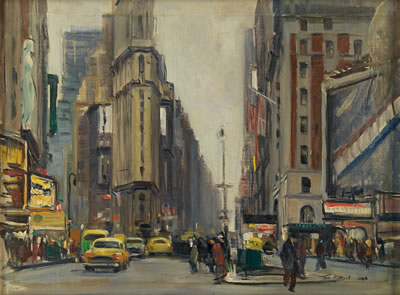
Tore Asplund was brought to the United States when he was a year old. He studied in New York at the Art Students League, the Academy school, and the Grand Central Art School. His preferred medium was... Read full biography
Tore Asplund was brought to the United States when he was a year old. He studied in New York at the Art Students League, the Academy school, and the Grand Central Art School. His preferred medium was watercolor and it was in the watercolorist class that he was elected to membership in the Academy.... Read full biography
Tore Asplund was brought to the United States when he was a year old. He studied in New York at the Art Students League, the Academy school, and the Grand Central Art School. His preferred medium was watercolor and it was in the watercolorist class that he was elected to membership in the Academy. During World War II Asplund served as a combat artist while in the Coast Guard. He might be best remembered for his paintings of the Omaha Beach landing on D-Day made from sketches taken as the... Read full biography
Tore Asplund was brought to the United States when he was a year old. He studied in New York at the Art Students League, the Academy school, and the Grand Central Art School. His preferred medium was watercolor and it was in the watercolorist class that he was elected to membership in the Academy. During World War II Asplund served as a combat artist while in the Coast Guard. He might be best remembered for his paintings of the Omaha Beach landing on D-Day made from sketches taken as the historic event was unfolding. His extensive travels in the United States, Canada, and Europe are recorded in many of his watercolors. He received the Academy's prize for watercolor in 1953; The Salmagundi Club, the Baltimore Watercolor Club, and the... Read full biography
Tore Asplund was brought to the United States when he was a year old. He studied in New York at the Art Students League, the Academy school, and the Grand Central Art School. His preferred medium was watercolor and it was in the watercolorist class that he was elected to membership in the Academy. During World War II Asplund served as a combat artist while in the Coast Guard. He might be best remembered for his paintings of the Omaha Beach landing on D-Day made from sketches taken as the historic event was unfolding. His extensive travels in the United States, Canada, and Europe are recorded in many of his watercolors. He received the Academy's prize for watercolor in 1953; The Salmagundi Club, the Baltimore Watercolor Club, and the American Watercolor Society also conveyed awards on his works. Asplund served two three-year terms on the Academy Council, from 1960... Read full biography
Tore Asplund - Artist Info
About Tore Asplund: Books
Books & Publications (11)
Publications based on askART research. List may not be comprehensive.
Salmagundi Club Painting Exhibition Records 1940-1951 and Water Color Exhibition Records 1900-1951
2009
Katlan, Alexander W.
623 pages
The Artists Bluebook 34,000 North American Artists to March 2005
2005
AskART.com Inc. - Dunbier, Lonnie Pierson (Editor)
479 pages
Davenport's Art Reference: The Gold Edition
2005
Davenport, Ray
2,421 pages
Who Was Who in American Art, 1564-1975: Three Volumes
1999
Falk, Peter Hastings (Editor)
3,724 pages
The Art Students League of New York A History (Teachers)
1999
Steiner, Raymond J
0 pages
Annual Exhibition Record, National Academy of Design: 1901-1950 (Exhibition catalog)
1990
Falk, Peter Hastings
622 pages
Watercolorists at Work
1972
Meyer, Susan/Norman Kent
160 pages (color)
100 Watercolor Techniques
1968
Kent, Norman
216 pages (color)
Color A Complete Guide for Artists
1967
Fabri, Ralph
175 pages (color)
History of the National Academy of Design, 1825-1953
1954
Clark, Eliot
296 pages
Mallet's Index of Artists: International-Biographical Two Volumes: Includes 1940 Index