Page loaded successfully. Showing keywords for Andrew John Henry Way.
Artist Keywords
Keywords page for Andrew John Henry Way ((1826 - 1888)), known for Fruit still life "portraits", grapes, oysters. Showing associated keywords and tags.
Andrew John Henry Way KEYWORDS
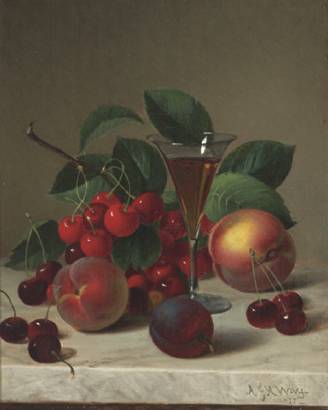
1826 Washington District Of Columbia - 1888 Baltimore, Maryland. Known for: Fruit still life "portraits", grapes, oysters.
Still life, portrait and landscape painter, Andrew John Henry Way was born in Washington, D. C., 27 April, 1826 and died in Baltimore, Maryland, 7 February, 1888. He studied first with John Peter... Read full biography
Still life, portrait and landscape painter, Andrew John Henry Way was born in Washington, D. C., 27 April, 1826 and died in Baltimore, Maryland, 7 February, 1888. He studied first with John Peter Frankenstein in Cincinnati (c. 1847), then with Alfred Jacob Miller in Baltimore (late 1840s). In 1850... Read full biography
Still life, portrait and landscape painter, Andrew John Henry Way was born in Washington, D. C., 27 April, 1826 and died in Baltimore, Maryland, 7 February, 1888. He studied first with John Peter Frankenstein in Cincinnati (c. 1847), then with Alfred Jacob Miller in Baltimore (late 1840s). In 1850 he went to Paris to study at the studio of Michel-Martin Drolling and in 1851 at the Academia della Bella Arte, Florence. After a stay in Europe of four years he returned to his native country,... Read full biography
Still life, portrait and landscape painter, Andrew John Henry Way was born in Washington, D. C., 27 April, 1826 and died in Baltimore, Maryland, 7 February, 1888. He studied first with John Peter Frankenstein in Cincinnati (c. 1847), then with Alfred Jacob Miller in Baltimore (late 1840s). In 1850 he went to Paris to study at the studio of Michel-Martin Drolling and in 1851 at the Academia della Bella Arte, Florence. After a stay in Europe of four years he returned to his native country, settling in Baltimore. For some time he was mainly a portrait painter, but a fruit-piece that he painted about 1859 attracted the attention of Emanuel Leutze, noted German-American painter, on whose advice he devoted himself thereafter to the painting of... Read full biography
Still life, portrait and landscape painter, Andrew John Henry Way was born in Washington, D. C., 27 April, 1826 and died in Baltimore, Maryland, 7 February, 1888. He studied first with John Peter Frankenstein in Cincinnati (c. 1847), then with Alfred Jacob Miller in Baltimore (late 1840s). In 1850 he went to Paris to study at the studio of Michel-Martin Drolling and in 1851 at the Academia della Bella Arte, Florence. After a stay in Europe of four years he returned to his native country, settling in Baltimore. For some time he was mainly a portrait painter, but a fruit-piece that he painted about 1859 attracted the attention of Emanuel Leutze, noted German-American painter, on whose advice he devoted himself thereafter to the painting of still-life subjects. He had great success creating still lifes, especially in the representation of grapes, those grown in the western United St... Read full biography
Andrew John Henry Way - Artist Info
About Andrew John Henry Way: Keywords
Keywords (24)
Art Method
- •Easel Painting
Art Media
Art Style
- •Realist, Representational, Naturalist Style
- •Trompe l'oeil
Art Subject
- •Botanics, Plant Life
- •Figure, Figurative Humans
- •Genre, Human Activity, Daily Life
- •Portraits, Portraiture
- •Still Life
Geography/Places Lived and/or Worked
- •Italy Before World War I
- •Paris Studied and/or Worked Before 1900
- •Washington DC Before 1900
Art Association
- •Brooklyn Art Association
Chronology
- •Early 19th Century Before Civil War
- •Late 19th Century, After Civil War
Art Collection
- •First National Bank of Chicago Collection
- •Haussner Collection, Baltimore
Added Description
- •Still Life Specialty
Exhibition/Expo: Regional/National/International
- •Centennial Exposition 1876, Philadelphia
Exhibition of Art Association
- •Brooklyn Art Association-
- •National Academy of Design, New York
Exhibition of Museum
- •Carnegie Institute, International Exhibition
Exhibition By An Art School
- •Royal Academy of the Arts, England
- •The Pennsylvania Academy of the Fine Arts